
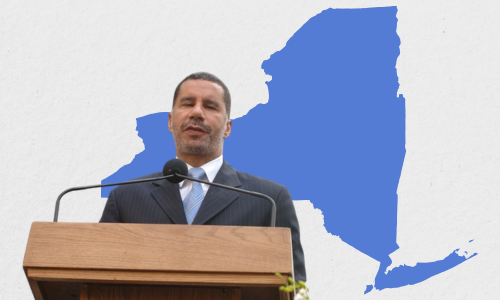
Governor David A. Paterson joined Michael Gormley, filling in for David Lombardo, on The Capitol Pressroom on October 8, 2026, to discuss bipartisanship and the lessons that earlier political relationships can offer today.
The conversation explores the friendships Paterson forged across the aisle during historic moments in Albany, and how those experiences could help improve contemporary politics.
Listen to the full interview
Interview Transcript
00:00:04.040 — Michael Gormley
You're listening to WCNY's The Capitol Press Room. I'm Michael Gormley, filling in for David Lombardo. Today we're speaking to David Paterson, the 55th governor of New York State. Welcome, Governor Paterson.
00:00:18.310 — Governor Paterson
Well, thank you, Michael. It's good to be here again.
00:00:20.780 — Michael Gormley
Great. Thanks for talking to us. We're hoping to talk a bit about some of the really historic moments of your tenure, but also how they may relate to lessons that could be learned, maybe should be learned in politics today. I'm going back to nearly 20 years ago, and I was a reporter for the Associated Press at the time, back when you took office. It was one of the most tumultuous times in state economic and political times, actually for the nation as well. Back then, when you assumed the office of governor after Eliot Spitzer resigned, you had, I think it was, a $4.6 billion gap in the budget that you were facing right away. And I think you had about 2 weeks to do a state budget. Um, do you remember, do you remember those wonderful times?
00:01:07.240 — Governor Paterson
I'll give you a break, Michael. It was 3 weeks. Like, like that was so much extra help. But what I did was I, I cashed in on a number of relationships that I had formed since 1985 when I first came to the Senate. So some of those people were Roy Goodman, who was the Republican senator opposite where I was the Democratic senator in Manhattan. And then I somehow got a little bit of a relationship going with John Dunn. who was the Republican Senate senator from Nassau County where I had grown up. So they were always really happy that, you know, a Long Islander had actually gotten to the Senate in New York. And then eventually and almost accidentally formed a little bit of a relationship with Senator Joe Bruno.
00:02:13.770 — Michael Gormley
Yes. And I actually— Governor, if I could interrupt you for a moment, I want to talk to you about that because I find that to be a fascinating moment in state government, and I covered it for 25 years. But your relationship with Republicans is something I want to get to very quickly here. And again, how can that be duplicated, hopefully, now or in the future here in politics? But I want to get back to this terrible, terrible time that you took office. In an extraordinary moment, you called that afternoon press conference on television And it was carried statewide. And you said that in 90 days, the state deficit grew by another $1.4 billion, that the nation was headed toward an economic crisis. Now, for listeners here, Governor David Paterson was one of the very first people to talk about what would eventually become the Great Recession. You gave out a warning well in advance of most elected officials, and you forced a rare summer session for the legislature. I gotta ask, you know, I remember, and you remember too, when people, when elected officials have given some dire warnings. Governor Jimmy Carter, when he basically tried to kick America's butt and say, get in gear, in his famous Malaise speech, and that hurt him politically.
00:03:41.560 — Michael Gormley
Governor Mario Cuomo, when he kept blocking the death penalty, hurt him tremendously. So you knew all that going in. And Governor, I got to ask you, what were you thinking?
00:03:56.380 — Governor Paterson
What I was thinking is fear. And if I could just tell you something, Michael, I don't know that I ever told you before. On the day that I'm sworn in as governor, which would be March 17th, 2008, I get a phone call from Charles O'Byrne. You remember Charles? He was my Chief of Staff, and he says, Governor, just hold on. You're going to get a call from President Bush in 10 minutes to wish you well. So I jump out of bed, I run in the shower. I'm halfway through the shower when I realize he's not FaceTiming me. I don't have to be dressed up. So I come out of the shower and I, and I get dressed up. And sure enough, I'm looking at the phone and it rings and I feel like I'm in a movie.
00:04:38.600 — Michael Gormley
And then it rings a second time.
00:04:39.050 — Governor Paterson
Finally, I pick it up and they She said, Governor Paterson. Well, I hadn't been sworn in yet, so I had to think about it. I said, uh, yes, we can go with that. She says, please hold on for the president. So I hold on, and about 30 seconds later, this voice says, how you doing up there?
00:04:57.070 — Michael Gormley
Oh, that's so great. That's great.
00:04:59.720 — Governor Paterson
I'm doing okay. He says, but, uh, you know what? You know what? I said, what? He says, my people tell me you've got everything under control. And then, Michael, I said, well, with all due respect, Mr. President, your people have been wrong before. And he busted out laughing.
00:05:16.590 — Michael Gormley
Isn't that—
00:05:17.400 — Governor Paterson
And I realized later that's not necessarily the reaction you'd get from a president. But it was my introduction to him and I got to know him. And it was one of the best associations I ever had in my political days with him. And he is Hilarious. He's one of these people that you can't go 10 minutes without him, you know, going off on a tangent that's incredibly funny.
00:05:41.870 — Michael Gormley
That's just fascinating. That is. And, um, we'll talk a bit more about that. But, you know, again, I want to go back. I've, I've covered, like I said, I've been a daily reporter until recently. Um, when you came out and on camera, looking right at the camera, said we're facing some of the worst times since the, um, the the Great Depression. And no one else was really out there saying that. I don't see an awful lot of that now. I know people who—
00:06:09.240 — Governor Paterson
Well, I got, I got the information and also the request from my own budget office that, you know, we've worked with other people in your position and everything with them is political and this isn't the right time. let's wait 3 months until you're in longer and that kind of thing. But with me, I wouldn't let them do it. I said, I want to know exactly the way things stand right now. And in 3 months, we'll worry about what's going on in 3 months. And I, I think that my willingness to basically take from the conversations what I thought was most important. By the time I got on the stage, I felt like I was playing with the house's money. I knew I was telling the truth. I could just tell that the economy was faltering and also could sense that there was going to be a lot of difficulty passing our own budget because of the deficits that the state was running up.
00:07:20.730 — Michael Gormley
Let me just pause here for a second. Before we continue, let me reintroduce who speaking with today. This is WCNY's The Capitol Press Room, and we're speaking with Governor David Paterson about his tenure and about lessons learned in politics that could be applicable today and maybe hopefully will be. And Governor, as I was saying, you took that risk, and I knew that there had to have been people who were telling you, don't do this, don't be the person speaking about the problem. In fact, that's what A lot of, uh, risk managers that are hired tell politicians. Um, I don't see that happening today. Do you think politicians today can step forward and say something like that where the, the, the, the problem is actually on tape, on TV, in their mouth?
00:08:10.340 — Governor Paterson
It's almost as if the 2 major parties, while they argue on the floor of the Senate and the House, while they in the media criticize each other, While they make real negative campaign ads against each other in the elections that are coming up, they don't ever seem to sit down and talk to each other kind of off the record. Like, this is kind of like what we need. This is kind of how are we going to find a way to resolve this and just know that the public is going to condemn us together. if we don't separately come up with a solution, which is what I, you know, tried to do even when I was governor. I invited at times legislators from both parties in and they're looking at each other like, what is this?
00:09:04.830 — Michael Gormley
Right. It is the moment you had a honeymoon, a very brief honeymoon when you came in.
00:09:12.460 — Governor Paterson
It was about 3 hours.
00:09:14.080 — Michael Gormley
Well, it was longer than that because you had built up that that political capital and your— the respect that you had and the friendships you had here. But just a few months after that television press conference that you had, which was extraordinary, then you had to go and veto about— how many was it? Was it 6,000 bills, member items, pork barrel spending?
00:09:42.720 — Governor Paterson
I had to wipe it all out. And I was— I wiped out and I made sure that I wiped out areas that I had represented. Harlem, the Upper West Side, the Upper East Side. You know, I still was known by a lot of people in Long Island. The last person you'd want to know during that budget period was me. But in the end, we got ourselves situated by We had some more trouble in 2009, as you remember, but really going into 2010, we had pretty much cleaned the slate. And I was very proud of that.
00:10:24.060 — Michael Gormley
You had to— again, the vetoes, for listeners here, in Albany, when a governor vetoes a legislator's bill, especially these member items, That's a very painful thing for the legislator because this is spending that goes back to their home district. It's one of the most powerful tools of an incumbent.
00:10:46.720 — Governor Paterson
It's the Cub Scouts in their area.
00:10:48.870 — Michael Gormley
Right.
00:10:49.370 — Governor Paterson
It's old age facilities. It's hospitals to a certain degree, not that much, but certainly, you know, places that serve people with different types of problems where they come in and then they go home. And when you're the one that has to do it, God is your conscience. Because your regular conscience has had enough. I want to go home.
00:11:23.970 — Michael Gormley
I thought that a few times.
00:11:24.790 — Governor Paterson
I said, can I go home now?
00:11:27.880 — Michael Gormley
I remember you brought some reporters in. I was one of them. to sit there in this big stack of bills that you just had to sign each time. One of them was lobbied very hard by your mother. Do you remember that? You vetoed your mother's bill.
00:11:43.570 — Governor Paterson
Yeah, I did. Well, it had to do with academic services. And my mother, who was a schoolteacher at P.S. 116 in Queens at the time. Well, she was when I was younger, and— but she gave up the job to be an advocate for me and, you know, basically forced me on the Hempstead public school system, forced me on a school called Fulton School, where they finally let me in 2 weeks after the school had started. Can you believe that?
00:12:22.290 — Michael Gormley
Oh, man.
00:12:22.990 — Governor Paterson
And 46 years later, they named the school after me. So I got the last laugh. But, but it, but, but it, it, it's, it's just such a difficult thing to do because when you're on the other end and I was on the other end one time, the governor wiped out— I only put in like 5 requests. I thought if I put in fewer, They'll take mine. No, they threw them out right away because they were afraid that they would rather me be angry than the people they were really going to hurt later on.
00:12:58.200 — Michael Gormley
Right. And you maybe, you might be a little less vindictive, um, at that time. Um, we're going back to when you were minority leader, the Democratic leader of the Senate, um, in the minority at that time. We're going to take a quick break now. And when we come back, we'll continue our conversation with former Governor David Paterson. He's talking about how he, as a black kid from Harlem who became governor, forged an important relationship with a rural kid from upstate New York who became leader of the Senate.
00:13:45.110 — Michael Gormley
Support for the Capitol Press Room comes from O'Donnell and Associates, a public affairs firm providing strategic guidance to businesses and nonprofits on navigating policy and regulatory issues. More information is available at odonnellsolutions.com.
00:14:03.060 — Michael Gormley
You're listening to WCNY's the Capitol Press Room. We're continuing our discussion with Governor David Paterson. One thing that was very interesting, which you've mentioned here before, is that you could talk to Republicans. I mean, part of that was it was an era when there were still Democrats and Republicans talking to each other, going to the bars downtown before cell phones.
00:14:25.660 — Governor Paterson
Yeah.
00:14:26.700 — Michael Gormley
But you had a fascinating relationship long-term with Republican conservative Senate Majority Leader Joseph Bruno. He's an upstate rural kid. You were a Harlem kid. Um, it would seem like there'd be nothing there, but what was that relation? How did you forge that? And how successful had that been?
00:14:48.220 — Governor Paterson
Well, when I first came to the Senate, and I really thought that it was a tribunal where you were really debating, when it's really just each side puts their position on the table and then we vote, I found that my colleagues in the Democratic Party, And I understood it would become very antagonistic at some points when they weren't allowed to finish speaking or they were being interrupted or, you know, something like that. So what I did to try to counteract it was to reach out to the Republicans before I made my point. So I would say, Senator Volcker, you know, I read this bill. I see a lot of good points in it. and I think it would certainly help the state, but I think it would help a little more if you would consider these alternatives in your own bill. It's kind of hard to yell at someone that says something like that, you know? So I would just try to make friendship with them even while I'm telling them I'm gonna vote against your bill.
00:15:50.780 — Michael Gormley
Well, that's the push and pull or part of it in politics too. Again, for listeners, David Paterson is being a head of a, the Democratic conference, had to try to work with Republicans who were in the majority, but couldn't be seen as abandoning the Democratic principles. In fact, while you and Joe Bruno were getting along on legislation, you were taking away seats in elections from him all the time.
00:16:19.730 — Governor Paterson
Yeah, I'll have to admit to it now. They wondered who it was. And what I did was we would always run a candidate against their candidate, no matter what seat it was. So you've got 61 senators and you've got 61 races. I stopped running races where we'd get creamed, and I got it down to say maybe 5 strong candidates, 15, maybe if we get lucky, and 40 not run at all. And that was how I think we were able to start to turn things around.
00:16:53.780 — Michael Gormley
Right. That worked because the Democrats eventually became the majority in the Senate.
00:16:58.120 — Governor Paterson
They sure did. And the leaders that followed me used the same plan to win the majority.
00:17:06.370 — Michael Gormley
And Governor, you continue to advise politicians. I know today that you get the phone calls. Can politics return to that period where there was cooperation, even friendships across the aisle? Can that happen now in Albany and in Washington? I mean, politics writ large.
00:17:25.830 — Governor Paterson
You know, Michael, we got through this whole interview and you finally asked the question that makes me feel bad. I don't get as many phone calls as I thought I would. Whereas when I was starting out, I'd call up people who'd left it. I called up a state senator representing the same district I had years before, and his name was Basil Paterson.
00:17:48.020 — Michael Gormley
Yes, your father.
00:17:49.780 — Governor Paterson
And but, but I would call other people. And I would call again retired Republicans, you know, that were still interested in the process and ask them questions and that kind of thing. And that's why I think I was able to build trust. And from that trust, I felt the Republican majority when I was governor coming in with absolutely no notice, helped me pass that bill within 5 days of the deadline. back in 2008. And, uh, I mean, it might have been 10 days. And I thought the only way that happened was they wanted to see me succeed, and they knew if I succeeded as governor, I had the ability to help them succeed.
00:18:37.350 — Michael Gormley
Can that happen again though? Um, maybe, maybe not even with the current politics in Albany, the current politics in Washington. Maybe we have to go through a couple election cycles to get some of the people out, but I just don't see any of that now. I mean, do you? Do you have hope that we're going to return to a point where—
00:18:55.380 — Governor Paterson
Not only do I have hope, Michael, I'm coming back. I'm coming back. I'm making that announcement right now. I don't know where and when, but I'm going to do it.
00:19:03.930 — Michael Gormley
Okay, well, you'll get a lot of people.
00:19:05.550 — Governor Paterson
Very seriously, I think unfortunately we are in just an era of antagonism in an era, in many ways, dishonesty when you're representing others' positions. Like, I saw a commercial where they were putting down something that this congressman did, and then they have his voice say, that's how I govern. So they put together a statement he never made with a statement he did make, but they left that part out. And I said, you know, see, that is dirty.
00:19:41.190 — Michael Gormley
Right.
00:19:41.740 — Governor Paterson
And I'm not even going to say which side did it, but it had no place in campaign commercials, I thought.
00:19:48.420 — Michael Gormley
Before we continue, this is WCNY's The Capitol Press Room, and we are speaking with former Governor David Paterson. Governor, I'm wondering too if you have seen this concern that you have too of this sharply partisan politics. Is it going down beyond the people we see in Washington and in Albany, the principles, you know, is it going down to the next, to the bench, to the next bunch of political leaders?
00:20:17.950 — Governor Paterson
I'm remembering people who, because, you know, I've been out of the process, I guess, 16 years now, but people who are still there. And it's almost as if they underwent some sort of, you know, What are they, satanic, you know, hypnosis because of the way they speak now as opposed to how they spoke then? And why can't good debates end on a handshake? And why can't senators and assembly members go and visit the offices of people who are on the other side of the aisle? By the way, I made a little reference to Senator Dale Volcker back when he was around in those days. And When, uh, I voted against his bill and he didn't think I understood why I voted against it, he came to my office. I wanted to hide under my desk.
00:21:14.870 — Michael Gormley
He was an imposing figure. Very—
00:21:17.530 — Governor Paterson
Oh, he was a big shot in his time. He was a sheriff.
00:21:20.250 — Michael Gormley
Concerned.
00:21:20.590 — Governor Paterson
I thought he might have brought his gun along, you know. And, uh, we sat there and had the most interesting conversation. On like a short list of 5 that I had in all the time I was in public service in Albany.
00:21:35.070 — Michael Gormley
Oh, that's, that's interesting. It, it would be just good for the public if that could return. You'll get better legislation, right? You'll get better understanding.
00:21:45.450 — Governor Paterson
And Michael, even after the conversation, when I was, um, walking over to, you know, talk to someone on the other side of the aisle and his seat because there were more of them than there were of us, was on the Democratic side. I'd pat him on the shoulder. He's, hi, Dave. I said, you look good in a Democratic seat. And I'd walk away. You know, you have to— you just can't take life and circumstances too seriously. You just can't do it.
00:22:13.700 — Michael Gormley
You know, there was another moment in your tenure back in 2008, I believe it was. You took this major step, really, towards the legalization of same-sex marriage. It required state agencies to recognize gay marriage performed in other states, and that started that momentum to eventually, you know, gay marriage was approved and legalized under Governor Andrew Cuomo. In your effort to push that issue, that very difficult issue back then, I'm not sure many people even remember how difficult that was at that time, You got the support of then former Senate Majority Leader Joseph Bruno, a conservative Republican, and you got many Republicans who came over to at least privately tell you they were supportive. How does that happen? Because that's not government policy, dry government policy. That was a very emotional issue. How did you talk to Joe Bruno? How did you talk to others to try to convince them?
00:23:14.170 — Governor Paterson
Michael, the conversation began when I went to dinner with him as the minority leader and he was the majority leader. Now, I can't remember if Marty Connor went to dinner with him prior to that, but it seemed to me it was the first time that the leaders just had dinner together. And it was warm and we talked about our families and this and that kind of thing. And then we talked about, you know, issues. And I said, Joe, we're off the record. What do you think about gay marriage? He said, you know, if there was a way to do it and no one would get hurt, I think I could do it. I don't have anything against gay people. I don't morally have a view of how they should live and that kind of thing. And that's when I knew there was an opening. But I wouldn't come back to— of course, at the time I'm the minority leader, but You know, when I become governor, I came back to him and I said, you know, we could pass a bill recognizing gay marriages in other states. We recognize a whole lot of other things in other states.
00:24:20.710 — Governor Paterson
He didn't give me an answer at first, but he came back. He said, okay, we're going to do it, but if this blows up, it's on you.
00:24:28.620 — Michael Gormley
Wow.
00:24:29.100 — Governor Paterson
And I said, no, if it blows up, it's on you. He goes, how can you say that? I said, because you're the head of the Senate. I'm just, you know, over here in the executive mansion. So again, I had to a little humor in it, you know.
00:24:42.340 — Michael Gormley
You know, in retrospect, Governor, on a personal note, it would've been nice for you to mention that to a reporter at the time. That would've been— that was a real breakthrough. Real breakthrough.
00:24:51.620 — Governor Paterson
Oh man, it was. And, and, and I'm not entirely sure that he already thought this, or when I asked him the question that the breakthrough occurred. I sort of thought it was the latter. because he kind of put his head on his hands like he was really considering it. And, uh, he was really one of the most interesting people I ever met in life, uh, you know, leaving out politics.
00:25:22.310 — Michael Gormley
Yeah, I think a lot of us felt that way too. Um, the late Joe Bruno. Um, Governor, what would you, what would you tell young people today thinking about a career in politics or government? Is, can you wholeheartedly urge them to consider it, or do you have a reservation now?
00:25:38.990 — Governor Paterson
Well, I would like to see some dynamic, articulate young people who know what the offices are and would be willing to take the time to learn what it takes to actually get there. See, I had to some degree, Mike, at that time, God was smiling on me because when I won my original seat, it was because the previous senator, Leon Boggs, had passed away and I won the nomination within the party.
00:26:10.590 — Michael Gormley
Mm-hmm.
00:26:11.320 — Governor Paterson
Then I became the deputy minority leader when Marty Connor defeated Manny Gold to become the new leader after Fred Ornstein left. So I'm kind of moving up the chain, but I haven't really done anything, you know, to you know, fervently make that happen. And then I become the minority leader in 2002 at the end of the year when it was just kind of clear at that point the members had had enough of, of Marty Conner. And I've never even known exactly what it was, but I know that I went to, I thought, a nice lunch with Eric Schneiderman up in Albany on a Saturday because he was coming back from one of his séances or whatever he did. And he invited me to lunch and he put He puts a piece of paper on the table, Michael, that might as well have been an AR-15. There were 10 names on it. He said, these 10 people have signed an oath that they'll support you if you run for leader. So that's 10 for us and 3 for you. You have to get the 3 on your own. By the way, I said, what about me?
00:27:15.150 — Governor Paterson
They said, well, we put your name on.
00:27:16.570 — Michael Gormley
Well, Governor, that is the nitty-gritty of government. It's very difficult. But let's say, you know, I'm your nephew, and I go, you know, uh, you know, Uncle Governor, um, should I get into politics and gov— or government? What would you say?
00:27:32.880 — Governor Paterson
I'd say yes. I would say if that's, uh, something that interests you, I mean, don't get in it for the wrong reason, but there's so many things that go on in life that you might feel you were one of the people who was able to change it. We certainly created some, you know, rights for victims when I was in office. I don't know if they would have even addressed the issue of same-sex marriage when I was there. I mean, if I wasn't there. And it wasn't that I knew more than other people. It's just that I just relied on my ability to survive and just— it just seemed right. It sounded right. And the community was very well organized and they were, you know, very beholden to myself. And they were shocked, but yet beholden for Senator Bruno and also some other senators who voted for it and felt they were gonna have trouble in their districts. Not one senator lost.
00:28:36.720 — Michael Gormley
Yes.
00:28:37.140 — Governor Paterson
For voting for same-sex rights.
00:28:39.850 — Michael Gormley
Right. Some great lessons there, Governor. I appreciate it. As always, the time goes very fast. Thank you so much for your time, for your insights, for your advice, and, uh, uh, I want to, um, wish you the best of luck as you continue in your public and private life.
00:28:55.660 — Governor Paterson
Well, I don't know if you're able to hear because the microphones aren't that strong, but my wife interjected a comment during the, the, uh, interview. It was one of the, um, uh, when we were, you know, talking about how we organized, uh, the, the, uh, the leadership in, in the Senate. And so I will retire and Answer her question now.
00:29:18.360 — Michael Gormley
This has been WCNY's The Capitol Press Room. I'm Michael Gormley filling in for David Lombardo. Thank you, Governor Paterson, for joining us today.
00:29:26.930 — Governor Paterson
Well, thank you, Michael. I really enjoyed it.
00:29:33.700 — Michael Gormley
Thanks for listening to today's edition of The Capitol Press Room. For an insider take on what's happening in state government, check out our Dispatches from Planet Albany show Available wherever you get podcasts or at capitalpressroom.org.
00:29:46.350 — Governor Paterson
Join us again for Capital Press Room, a production of WCNY Connected Syracuse.